Warts are skin growths caused by specific strains of the human papillomavirus. Individuals of all ages can develop warts, and they can appear in several places on the body. While most warts are harmless, they can cause cosmetic concerns, spread to other areas of the skin or be a nuisance.
In this blog, Dr Vedant Ghuse, the top skin specialist in Ghatkopar, lists the different types of warts, as knowing about the various types will assist you in identifying them quickly in order to get treatment if needed.
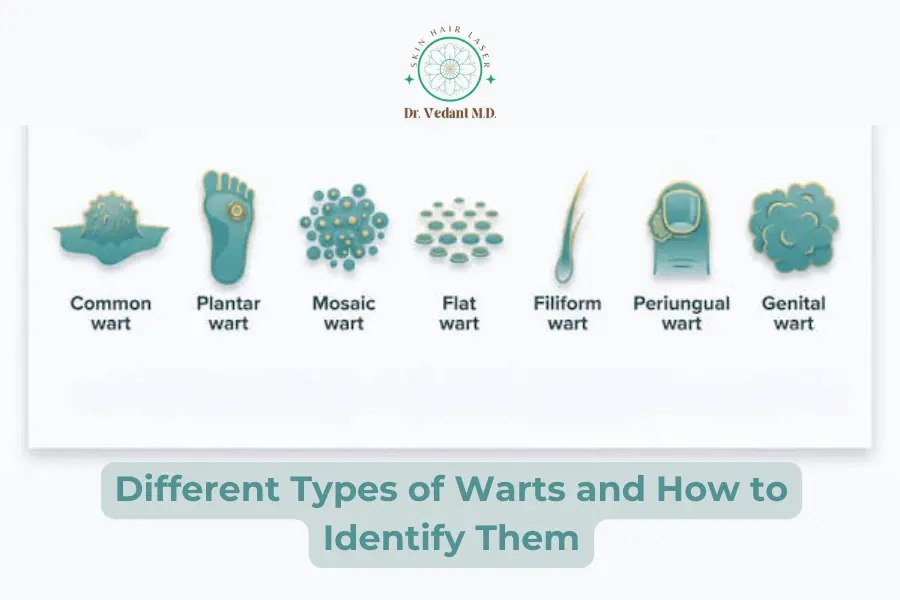
The most commonly seen warts are known as common warts. They most commonly appear on fingers, hands, around nails, and occasionally on knees. Common warts typically appear as small, raised bumps with a rough texture on their surface and a grainy appearance. Inside some of the common warts, you may see small black dots; these are actually tiny clotted blood vessels that develop inside the wart. Common warts can occur alone or in clusters, and direct contact with someone who has common warts can result in transmitting common warts to other areas of your skin.
Plantar warts are warts that develop on the bottom of your feet. Plantar warts grow inward because of the pressure from standing and walking, in contrast to most common warts, which grow outward. Plantar warts can appear as hard, thickened lumps of skin that are painful or uncomfortable to walk on. Often, people will confuse plantar warts with calluses. With plantar warts, you can see small black dots, and the warts may have indentations.
Compared to other types of warts, flat warts (also known as plane warts) are smaller and smoother than their counterparts. They can often grow in large quantities and are slightly raised with a flat top. Flat warts are frequently found and appear repeatedly on various locations of the body, such as the face, forehead, neck, hands, and legs. They often appear similar to other minor skin eruptions, such as acne, minor bumps on the skin, or irritation, making them difficult to distinguish from these conditions.
Filiform warts have a unique characteristic due to their shape. Dr Vedant, the best skin specialist near me, describes that they protrude from the skin at an elongated, narrow, finger-like angle. Filiform warts usually form in areas of the body that are most visibly seen (such as around one's mouth, nose, or eyes), meaning that, in contrast to other recurring or serial types of warts, filiforms can easily be identified and recognised immediately due to their distinct locations.
Genital warts are bumps or clusters that appear on the genitals or anus due to certain strains of HPV (the human papillomavirus). These could be small, flesh-coloured bumps, or they could be larger, more cauliflower-like clusters. However, many other skin growths have similar appearances, so it is important to have them evaluated by a medical professional so that an accurate diagnosis can be made and proper treatment can be provided.
While warts are generally harmless, not all skin growths are warts. Skin tags, moles, calluses, molluscum contagiosum, and some types of skin cancer are known to look like warts. Therefore, if you attempt to diagnose your own skin growth or remove a skin growth at home, complications such as infection or scarring may occur. Therefore, wait until you have had a professional evaluation before attempting to have your problem resolved.
A dermatologist is qualified to diagnose and treat skin growths such as warts and will know what type of wart the patient has. In addition, a dermatologist can recommend the most appropriate treatment based on the location and severity of the wart, including but not limited to cryotherapy, topical creams, electrocautery, laser therapy, and minor surgical procedures.
If you have an abnormal or persistent skin growth, different types of abnormal or persistent skin growths, or a growing wart, see a dermatologist like Dr Vedant Ghuse, a leading skin specialist doctor near me, for a professional evaluation so that early diagnosis and early treatment can be given, which helps to prevent complications.